
Dixie County Court Records After a Jail Arrest
An arrest in Dixie County does not create a court case by itself. The arrest and the booking come first. The court record comes later. When a deputy or another officer makes an arrest, the person is taken to the Dixie County Jail and booked. The sheriff's roster shows that booking and the charges the officer listed. After that, the State Attorney for the Third Judicial Circuit reviews the case. The prosecutor can file charges, change them, or decline them. When charges are filed, the Clerk of Court opens a case and holds the records. That filed case is the court record people search for after an arrest.
It helps to keep the two sides apart. The booking side lives with the sheriff. For the custody and booking detail, see the jail inmate records page, and for booking photos see the jail roster mugshots page. The court side lives with the Clerk of Court and the State Attorney. The roster charge at booking can differ from the charge the prosecutor finally files. That is why the court record matters. It shows what the prosecutor actually pursued, how the charge changed over time, and how the case ended. An arrest is only the start of that record.
How to Find Dixie County Court Records After an Arrest
Court charges and charge status show up in the county court index, not on the jail roster. The sheriff homepage links a "Court Records Search" tool that opens the Dixie County Online Court Records Search, run on the CiviTek Florida OCRS portal for county 15. The Clerk of Court also links the same search from its online services page. The portal is free. Public access is anonymous, so a basic lookup needs no account. The booking detail still lives on the jail roster, so many searches start there to grab a name, an arrest date, and any case number before moving to the court index.
Use the steps below to move from an arrest to the matching court record.
- Open the Dixie County OCRS portal and choose Public access for anonymous searching.
- Search by the defendant's name, or paste a case number if the jail roster showed one.
- Open the matching case and read the full charge list and each sequence number.
- Check each charge's statute, level, and current status, plus the docket and any future court dates.
Before you start, note the OCRS portal offers four access modes. The table below lists them. Only the Public mode is needed for an ordinary lookup. The other three are gated for people with a direct role in a case.
| Access Mode | Login Needed | Who It Is For |
|---|---|---|
| Public | No login | Anyone doing an anonymous court record search. |
| Attorney | User id and password | Attorneys of record viewing their own cases. |
| Registered User | User id and password | Approved registered users with expanded access. |
| Party Access | User id and password | A named party to a case. |
Online access to these records is governed by Florida court rule AOSC 16-107, which sets what the public may see and what stays restricted. The screen that appears after you click Public asks for search details, and those fields can change, so confirm them in your own browser. To preview the access screen, the lead-in below points to the official OCRS landing page.
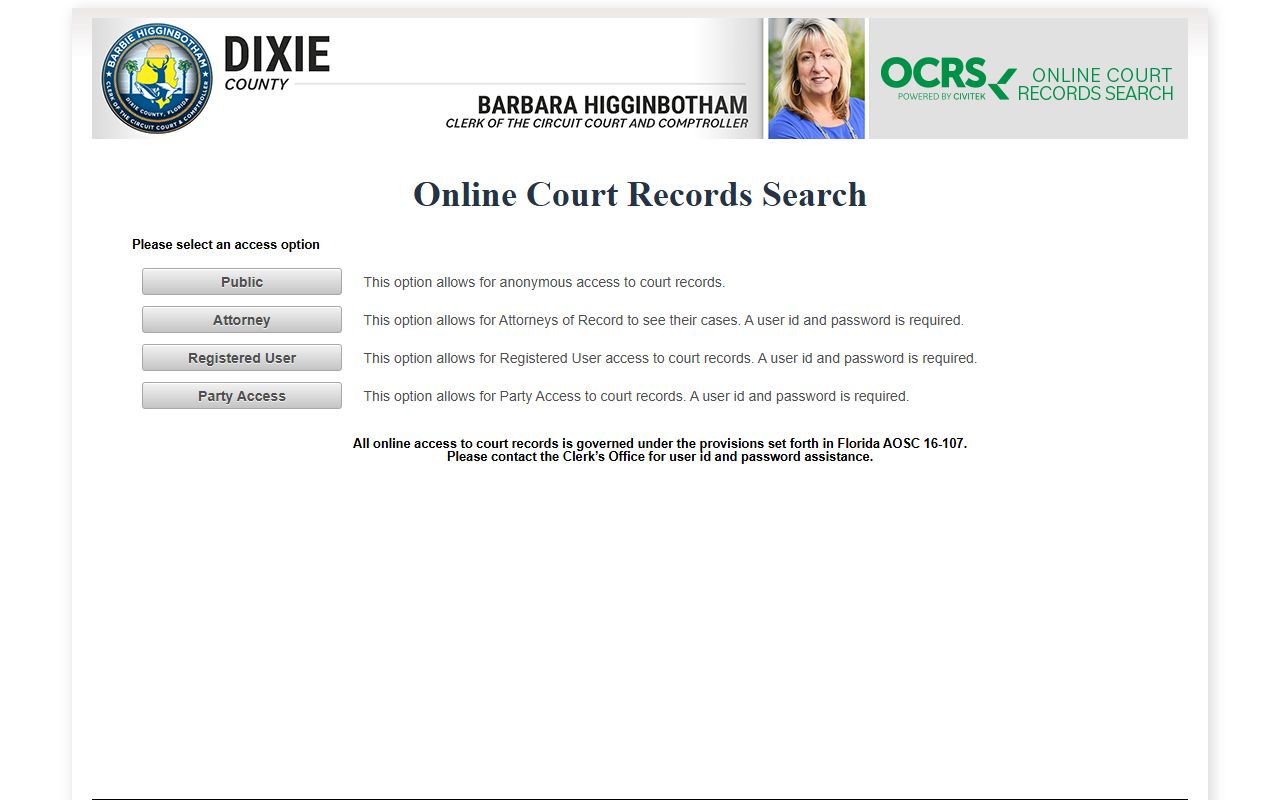
The screen shows the four access buttons and the rule notice that governs online court records. Click Public, then search by the defendant's name or by a case number to reach the case after an arrest.
Florida public records law backs this access. Florida Statute 119.07 requires record custodians to let people inspect and copy public records at reasonable times. Florida Statute 119.0714 covers court files and official records and sets which parts may be sealed or redacted. For a statewide picture rather than one county case, the Florida Department of Law Enforcement runs a paid criminal history check at the FDLE Florida criminal history page. An FDLE check pulls arrest history from across the state, but it can lag and may not include the actual court documents, so it is not a full replacement for the Dixie County docket.
How Charges Get Filed After a Dixie County Arrest
The court record begins with a charging document. After the booking at the jail, the State Attorney for the Third Judicial Circuit decides how the case moves forward. A prosecutor can file a charge, amend it, reduce it, decline it, or send a serious case to a grand jury. Three main charging documents start a criminal case in Florida. Each one matters because the document type signals how serious the charge is and who decided to bring it.
The table sorts the three by who files them and the cases they fit.
| Complaint | Information | Indictment | |
|---|---|---|---|
| Filed By | Officer or prosecutor | Prosecutor | Grand jury |
| Common For | Misdemeanors and the initial charge | Most Florida felonies | Capital and serious felonies |
| Starts | The case | The case | The case |
A complaint is the first sworn allegation. It can start a case before the prosecutor makes a final filing. An information is the formal charge a prosecutor files, and it is the usual route for Florida felonies that do not need a grand jury. An indictment is a charge returned by a grand jury, which Florida requires for capital offenses and uses in certain serious cases. The court record shows which document opened the case, and the docket logs the prosecutor's later filings.
Charge Status in Dixie County Court Records
Charges change as a case moves through court. A booking charge on the jail roster is the officer's listing at arrest. The court charge is what the prosecutor actually files, and it can be amended, reduced, added to, or dropped. That is why the roster and the court record sometimes do not match. Reading the status on each charge tells you where the case stands. The terms below appear often in Florida case dockets.
This table defines the common status labels you will see on a charge after an arrest.
| Status | What It Means |
|---|---|
| Pending | The charge is open and active. The case has not reached a plea, trial, or final outcome. |
| Amended / Reduced | The prosecutor changed the charge after review, such as lowering a felony to a lesser offense. |
| Dismissed | The charge is no longer pursued and is dropped. A dismissal is not a conviction. |
| Nolle Prosequi | A Latin term meaning the prosecutor formally declines to pursue the charge. |
If a case does not appear at all, several reasons are possible. The name may be spelled differently. The prosecutor may not have filed yet, or may have declined to file. The record could be sealed, confidential, or a juvenile matter. Old records may not be indexed online. The case may also sit in another county. The Clerk of Court can help when an online search comes up empty.
Note: The booking number on the jail roster and the court case number are not the same, so search the court index by both the defendant's name and any number the roster shows.
The Dixie County Clerk Holds the Court Record
The Clerk of Court is the office that keeps the case file after an arrest leads to a filed charge. The clerk runs the court records search and the official records search, and clerk staff can help with older, sealed, or non-indexed records that the public portal does not show. The clerk court information page also explains that the county handles both circuit criminal cases, which are felonies, and county criminal cases, which are misdemeanors. The clerk notes that most juvenile records are confidential, which is one reason a youth case may not show in the same public index as an adult case.
Below is the clerk's contact information and a look at the online services it offers.
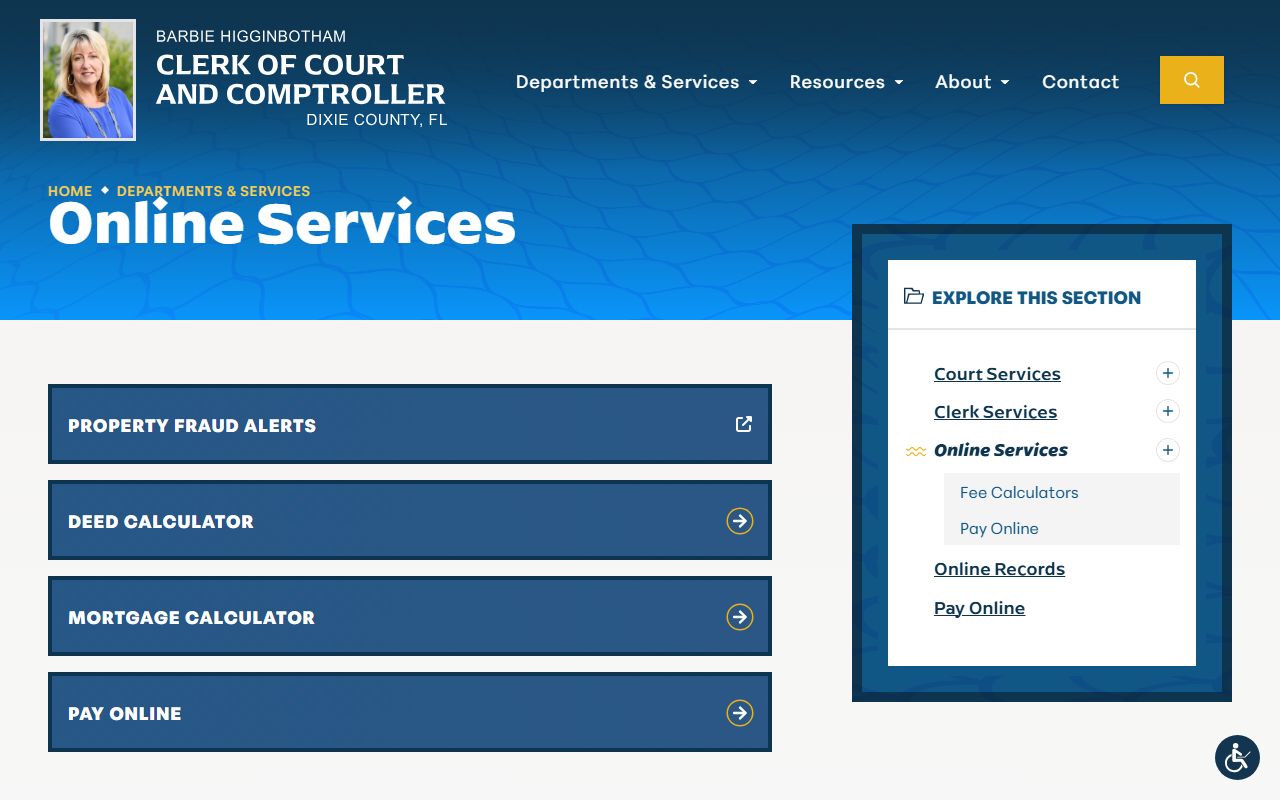
The clerk online services screen links the court records search and the official records search side by side. From the Dixie County Clerk online services page you can reach the same OCRS court index used to track a case after an arrest. The clerk's office sits at 214 NE Highway 351, Cross City, FL 32628, with phone (352) 498-1200 and hours Monday through Friday, 8:30 AM to 5:00 PM. Online searching is free, but certified or copied documents may carry a fee.
A court case search can return a lot of detail. The list below shows the field areas the official OCRS guide describes for a case.
- Case Number or Uniform Case Number that matches your search.
- Charge descriptions and the sequence number for each charge.
- Party names and the role each party plays in the case.
- Attorney of record and bar number, where listed.
- Dockets, which log case actions and related images.
- Court events, both past hearings and scheduled dates.
- Sentences and a financial summary, where they exist.
Some document images carry a lock icon marked View on Request, often shortened to VOR. That label means the clerk performs an extra redaction review before release. It does not mean the document is sealed. A normal image without the lock is available right away, with standard watermark or redaction already applied.
Who Files Charges After a Dixie County Arrest
Florida does not use county district attorneys. Instead, an elected State Attorney serves each judicial circuit. Dixie County falls under the State Attorney's Office for the Third Judicial Circuit. The same office serves Columbia, Hamilton, Lafayette, Madison, Suwannee, and Taylor counties as well. John Durrett is the current State Attorney. He was elected in August 2020 and sworn in on January 5, 2021. The sheriff books the arrest, but this office decides whether to prosecute and what charges go before the court. That choice shapes the court record more than the booking charge does.
The lead-in below points to the prosecutor's official homepage for a closer look at the office that handles Dixie County cases.
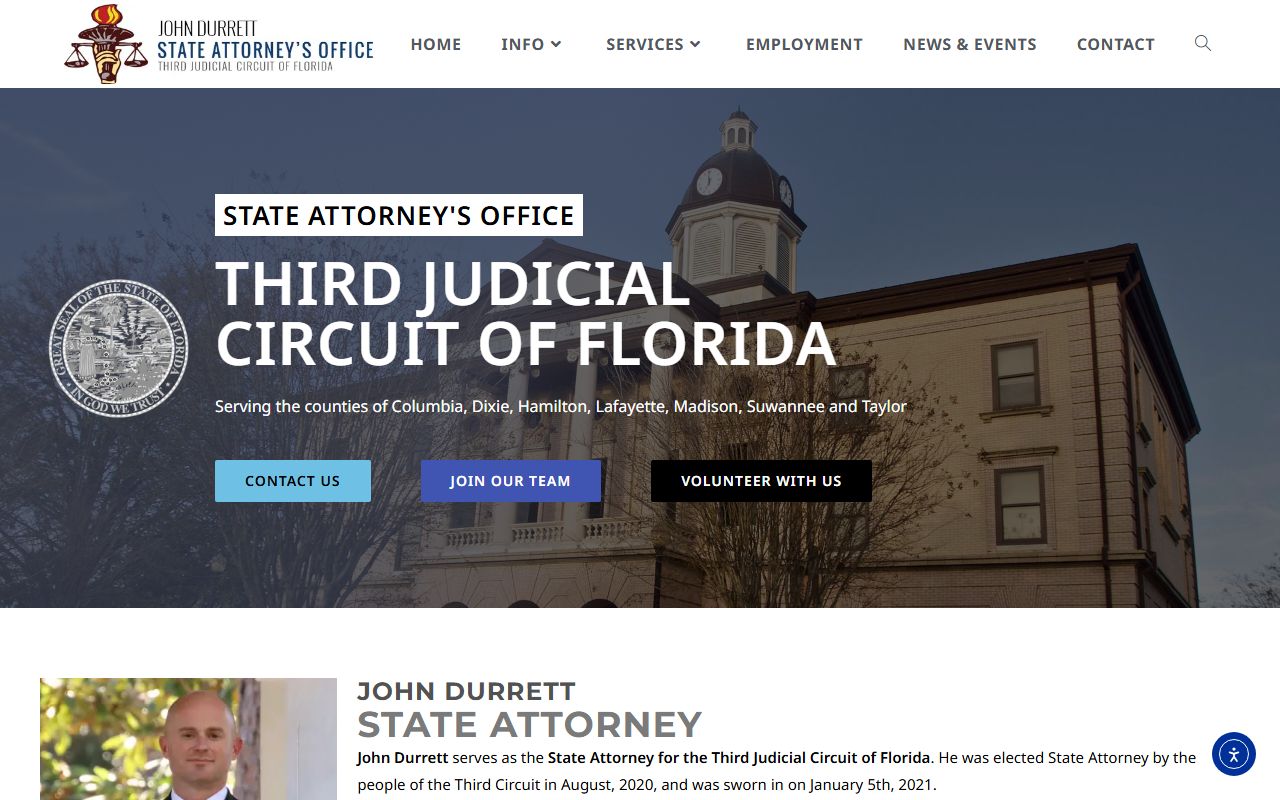
The Third Judicial Circuit State Attorney homepage names John Durrett and lists the seven counties the office serves. Assistant state attorneys review what law enforcement submits, then file or decline charges, handle pleas and dispositions, and work with victim services. For prosecution questions or victim help, this office is the right contact, not the sheriff. For hearing dates and case outcomes, the court record through the clerk is the place to look.
Bond and Release After a Dixie County Arrest
Bond decides whether a person waits for court at home or in jail. The sheriff's detention page says people who are arrested and do not bond out appear before a judge within 24 hours of arrest. At that first appearance, the judge states the charge or charges and the bond amount. The hearing can happen with the judge in the room or by phone or Polycom video. The jail roster shows both a summary bond amount and a bond figure on each charge, so the booking entry often gives a first read on what release will cost.
The table sorts the main bond types a Dixie County defendant may face.
| Bond Type | How It Works |
|---|---|
| Cash Bond | The defendant or another person posts the full amount the court set. |
| Surety Bond | A licensed Florida bail bond agent posts the bond for a fee or premium. |
| PR / Own Recognizance | The court releases the person on a promise to appear, with no full cash needed. |
| No-Bond Hold | Release is blocked until a hearing or case condition is resolved. |
A posted bond does not always mean release. A person may still be held on a hold or detainer. That can be a warrant from another county, a probation or parole violation, a state corrections hold, a federal hold, or an immigration detainer. The county jail runs 24 hours a day at (352) 498-1231. Call the jail before traveling to confirm the exact bond amount, the accepted payment method, and whether any hold prevents release. Inmate money deposit rules are not the same as bond payment rules, so do not assume one covers the other.
Warrants That Lead to a Dixie County Arrest
Many arrests start with a warrant. The Dixie County Sheriff's Office does not publish an online active-warrant search. The sheriff has a Civil Process and Warrants division, but that page mostly gives office contact and civil-process fees, not a searchable warrant list. The division sits inside the Sheriff's Office at 214 NE Highway 351, Suite L, Cross City, FL 32628. Its phone is (352) 498-1220, and its hours are Monday through Friday, 8:30 AM to 5:00 PM, closed on legal holidays. An arrest warrant follows probable cause to arrest. A bench warrant, also called a capias, is issued by a judge, often after a failure to appear.
The points below show where warrant information can and cannot be found.
- There is no public sheriff warrant list, so the roster will not show every outstanding warrant.
- Bench warrants and capiases may appear inside the OCRS case dockets, so search the defendant or case there.
- Call the Civil Process and Warrants division at (352) 498-1220 during business hours for warrant questions.
- FDLE criminal history may show arrest history but is not a live warrant-clearance tool.
When deputies, police, or another agency arrest a person on a warrant, the person can be transported to the Dixie County Jail. The booking then shows the arresting agency in the charge field and a status such as In Jail. Warrant bond may be set in the warrant, at first appearance, or by the issuing court, and some warrants are no-bond. Confirming an active warrant in person can lead to arrest, so handle that with the sheriff or court directly.
Note: A warrant turns into a court record only after the arrest and filing, so check both the sheriff division and the OCRS docket to trace the full path.
Charges vs. Convictions in a Court Record
An arrest and a charge are not the same as a conviction. A charge is an accusation. A conviction is the outcome. Many arrests never lead to a conviction. Charges get dropped, reduced, or beaten at trial. The court record shows both the charge and the final result, so reading the whole docket matters. A booking photo or a charge line on the roster proves only that an arrest happened, not that the person was found guilty.
The table sets the two side by side.
| Charge | Conviction | |
|---|---|---|
| Stage | Accusation | Verdict or plea |
| Burden of Proof | Probable cause | Beyond reasonable doubt |
| Public Record | Yes | Yes |
Both a charge and a conviction sit in the public court record. The key is the disposition, the court outcome on each charge. A disposition can read dismissed, pled, convicted, or acquitted. Read it on every charge before drawing any conclusion about a case.
Sealed vs. Expunged Records After an Arrest
Some people can clear a record after a dismissal or an eligible outcome. Florida treats sealing and expunction as two different court processes. A sealed record is hidden from public view but still exists, and certain agencies keep limited access. An expunged record is removed and treated as though it never existed, with access far more restricted. Both need a court order, and not every case qualifies. The rules sit in Florida law, and an eligible person usually works through the court and the state to start the process.
The table compares the two at a glance.
| Sealed | Expunged | |
|---|---|---|
| Visibility | Hidden from public view | Removed and treated as never existed |
| Law Enforcement | Limited access kept | Very limited access |
| Eligibility | Court order; one prior sealing or expunction generally bars another | Court order under Fla. Stat. 943.0585; often used after a dismissal or no-file |
The court-ordered expunction process sits in Florida Statute 943.0585. Access to court files and official records is governed by Florida Statute 119.0714, which sets how a sealed or expunged record is handled in the court index. When a court orders sealing or expunction, official systems restrict or remove the record to match that order. Eligibility is detailed, so confirm the current requirements with the clerk or a qualified attorney before relying on either route.
Background Checks and Court Records
People often confuse a casual court lookup with a formal background check. A free search of the Dixie County court index or the FDLE criminal history page gives a snapshot, but neither is built for hiring, housing, or lending decisions. The federal Fair Credit Reporting Act, known as the FCRA, sets strict rules for any report used to make those calls. A consumer reporting agency must follow those rules. A public court search does not.
Important: Information here is not a consumer report and not from an FCRA consumer reporting agency, so it cannot be used for credit, employment, housing, or insurance decisions.
Restricted Court Records After an Arrest in Dixie County
Not every record after an arrest is open to the public. Florida law shields some files from view. Florida Statute 119.071 lists exemptions that let an agency withhold or redact criminal justice material, victim data, protected identities, and certain sensitive information. The clerk also notes that most juvenile records are confidential, so a youth case often will not appear in the public adult index. Sealed and expunged cases are removed or hidden by court order. Active investigations can keep records out of view until the work is done.
When a search turns up nothing, that absence may not mean no case exists. The record could be restricted, confidential, or simply not indexed online yet. Contact the Dixie County Clerk for help with older or non-indexed files, and use the State Attorney for prosecution and victim-services questions. Each office holds a different piece of the path that runs from an arrest to a finished court record.